#61 at the time of writing.
The futility and irony of the trench warfare of WWI is shown as a
unit commander in the French army must deal with a mutiny and a
glory-seeking general. I was lucky enough to watch this early Kubrick masterpiece at my local cinema recently, and the film's story and message have lingered with me for days.
As the closing credits rolled I found myself both exhilarated and depressed. Could Colonel Dax have done anything differently? What would I have done in his situation? Who was most to blame, and to what degree was any kind of justice served? These questions roiled around in my head afterwards.
Kubrick's early reputation as a prodigy was richly deserved. There is no sentimentalism here, no "patriotism" clouding the absurdity and cruelty of war. It is simply but cleverly filmed. The long tracking shots build tension and heighten emotion. There is a subtle emphasis on the stark contrast of the safe and opulent château where senior officers planned the war, and the stinking trenches where men followed orders with fear and loyalty knowing that death was their ultimate reward. And the final scene was extremely moving - nothing to do with the rest of the story, but underscoring the message that war makes us forget our humanity.
Impressive also, is that Kirk Douglas was in his 40s when he starred in this 1957 movie, and he's still around today. One of the last remaining stars of the Golden Age of Hollywood.
The brief essay at the Criterion Collection provides an enlightening insight into the film.
Some interesting trivia from IMDb and other sources (if you believe it):
Winston Churchill claimed that the film was a highly accurate depiction of trench warfare and the sometimes misguided workings of the military mind.
The epic battle sequence was filmed in a 5,000-sq.-yd. pasture rented from a German farmer. After paying for the crops that would have been raised that season, the production team moved in with eight cranes and as many as 60 crew members working around the clock for three weeks to create trenches, shell holes and the rough, muddy terrain of a World War I battleground.
For box office reasons, Stanley Kubrick intended to impose a happy ending. After several draft scripts he changed his mind and restored the novel's original ending. Producer James B. Harris then had to inform studio executive Max E. Youngstein and risk rejection of the change. Harris managed by simply having the entire final script delivered without a memo of the changes, on the assumption that nobody in the studio would actually read it.
Concerned by its negative portrayal of the French army, the French government urged distributors United Artists not to release the film, and so it was not submitted to the censors, and not shown in France until 1975. Switzerland also banned the film (until 1978), accusing it of being "subversive propaganda directed at France." Belgium required that a foreword be added stating that the story represented an isolated case that did not reflect upon the "gallantry of the French soldiers."
Director Stanley Kubrick met Christiane Kubrick (then Christiane Harlan) during filming; she performs the singing at the end of the film. He divorced his second wife the following year to marry her, and they remained married until his death in 1999.
Actor (and colourful off-stage character) Timothy Carey was fired during filming, allegedly for some disruptive attempts at self-publicity including a staged kidnapping. His final scenes were shot with a double.
Showing posts with label 1957. Show all posts
Friday, September 12, 2014
Tuesday, June 02, 2009
Best Year for Film?
I was musing the other day about how 1999 was a truly fantastic year for film. Fight Club, The Matrix, American Beauty, Being John Malkovich, South Park... even Toy Story 2 was colossal. I used to love films, but after 1999 I became obsessed.
I wonder, what year was the best ever for film? 1939 also seems stuck in my head as a great year (The Wizard of Oz, Gone with the Wind). But what about the sixty years in between?
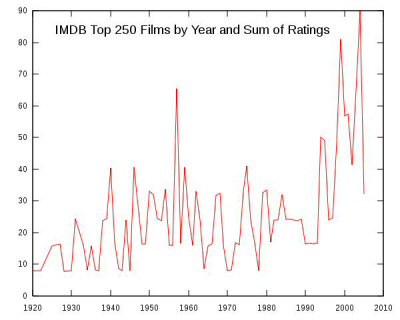
Geeky as I am, I decided to run the stats on IMDb's Top 250 list. Here's the rundown:
The earliest film on the Top 250 is from 1921 (The Kid). Since then, only seven years do not feature in the Top 250 at all: 1924, 1928, 1929, 1932, 1935, 1937 and 1947. (1947 misses out despite Miracle on 34th Street - which goes to show how many wonderful and well-loved films must fall just short of IMDb's Top 250.)
Years that appear once each in the Top 250:
1921
1922
1923
1925
1926
1930
1934
1942
1956
1964
1965
1970
1978
1990
The early 1920s is in danger of dropping off the list altogether.
Years that appear twice each in the Top 250:
1927
1933
1936
1938
1941
1943
1945
1949
1955
1958
1963
1969
1971
1972
1973
1977
1981
1983
1985
1987
1989
1991
1992
1993
1996
2009
Although 2009 may yet get promoted.
At this point there are only half a dozen years left before 1950. Does that mean that films didn't used to be as good? Or that our tastes have moved on? Or that the best early films just don't get watched any more? Most likely all of the above.
Years that appear three times each in the Top 250:
1931
1939
1944
1948
1952
1953
1961
1962
1966
1974
1976
1982
1984
1986
1988
2002
2005
Well, this is a very unscientific measure, but there goes 1939...
(Actually, this is quite a scientific measure, but therein lies it's fault. You can't rightly judge great films using scientific measures.)
Years that appear four times each in the Top 250:
1950
1951
1960
1967
1968
1979
1980
1997
1998
2001
Now the big hitters. There are fifteen years left - the fifteen greatest years for film.
Years that appear five times each in the Top 250:
1940
1946
1954
1959
1975
Good to see that plenty of golden oldies are still very much appreciated.
Years that appear six times each in the Top 250:
1994
1999
2000
2003
2007
So 1999 truly was a great year for film after all. Yet 1994 was even greater - with The Shawshank Redemption in the #1 slot and Pulp Fiction at #5.
Finally, the top 5 years for film... drumroll please...
#5: 2004
Eternal Sunshine of the Spotless Mind
Downfall
Hotel Rwanda
Million Dollar Baby
The Incredibles
Crash
Kill Bill: Vol. 2
#4: 2006
(Same number of films on the Top 250 as 2004, but higher rated on average, so more likely to stay there.)
The Departed
The Lives of Others
Pan's Labyrinth
The Prestige
Children of Men
Letters from Iwo Jima
Little Miss Sunshine
#3: 1995
(Ditto.)
The Usual Suspects
Se7en
Braveheart
Heat
Toy Story
Twelve Monkeys
Casino
#2: 1957
The top ten years are all within the last decade and a half, except 1957. This defiance of the bias suggests that 1957 is our true winner.
12 Angry Men
Paths of Glory
The Bridge on the River Kwai
The Seventh Seal
Witness for the Prosecution
Wild Strawberries
Nights of Cabiria
Sweet Smell of Success
#1: 2008
No fewer than nine films in the Top 250, with a very strong average ranking - although not as strong as 1957.
The Dark Knight
WALL·E
Slumdog Millionaire
Gran Torino
The Wrestler
The Curious Case of Benjamin Button
Let the Right One In
In Bruges
Changeling

I wonder, what year was the best ever for film? 1939 also seems stuck in my head as a great year (The Wizard of Oz, Gone with the Wind). But what about the sixty years in between?
Geeky as I am, I decided to run the stats on IMDb's Top 250 list. Here's the rundown:
The earliest film on the Top 250 is from 1921 (The Kid). Since then, only seven years do not feature in the Top 250 at all: 1924, 1928, 1929, 1932, 1935, 1937 and 1947. (1947 misses out despite Miracle on 34th Street - which goes to show how many wonderful and well-loved films must fall just short of IMDb's Top 250.)
Years that appear once each in the Top 250:
1921
1922
1923
1925
1926
1930
1934
1942
1956
1964
1965
1970
1978
1990
The early 1920s is in danger of dropping off the list altogether.
Years that appear twice each in the Top 250:
1927
1933
1936
1938
1941
1943
1945
1949
1955
1958
1963
1969
1971
1972
1973
1977
1981
1983
1985
1987
1989
1991
1992
1993
1996
2009
Although 2009 may yet get promoted.
At this point there are only half a dozen years left before 1950. Does that mean that films didn't used to be as good? Or that our tastes have moved on? Or that the best early films just don't get watched any more? Most likely all of the above.
Years that appear three times each in the Top 250:
1931
1939
1944
1948
1952
1953
1961
1962
1966
1974
1976
1982
1984
1986
1988
2002
2005
Well, this is a very unscientific measure, but there goes 1939...
(Actually, this is quite a scientific measure, but therein lies it's fault. You can't rightly judge great films using scientific measures.)
Years that appear four times each in the Top 250:
1950
1951
1960
1967
1968
1979
1980
1997
1998
2001
Now the big hitters. There are fifteen years left - the fifteen greatest years for film.
Years that appear five times each in the Top 250:
1940
1946
1954
1959
1975
Good to see that plenty of golden oldies are still very much appreciated.
Years that appear six times each in the Top 250:
1994
1999
2000
2003
2007
So 1999 truly was a great year for film after all. Yet 1994 was even greater - with The Shawshank Redemption in the #1 slot and Pulp Fiction at #5.
Finally, the top 5 years for film... drumroll please...
#5: 2004
Eternal Sunshine of the Spotless Mind
Downfall
Hotel Rwanda
Million Dollar Baby
The Incredibles
Crash
Kill Bill: Vol. 2
#4: 2006
(Same number of films on the Top 250 as 2004, but higher rated on average, so more likely to stay there.)
The Departed
The Lives of Others
Pan's Labyrinth
The Prestige
Children of Men
Letters from Iwo Jima
Little Miss Sunshine
#3: 1995
(Ditto.)
The Usual Suspects
Se7en
Braveheart
Heat
Toy Story
Twelve Monkeys
Casino
#2: 1957
The top ten years are all within the last decade and a half, except 1957. This defiance of the bias suggests that 1957 is our true winner.
12 Angry Men
Paths of Glory
The Bridge on the River Kwai
The Seventh Seal
Witness for the Prosecution
Wild Strawberries
Nights of Cabiria
Sweet Smell of Success
#1: 2008
No fewer than nine films in the Top 250, with a very strong average ranking - although not as strong as 1957.
The Dark Knight
WALL·E
Slumdog Millionaire
Gran Torino
The Wrestler
The Curious Case of Benjamin Button
Let the Right One In
In Bruges
Changeling

Labels:
1921,
1939,
1957,
1994,
1995,
1999,
2004,
2006,
2008,
best year for film,
films,
Gone with the Wind,
Miracle on 34th Street,
movies,
Pulp Fiction,
statistics,
The Kid,
The Shawshank Redemption,
The Wizard of Oz,
Top 250
Subscribe to:
Posts (Atom)