#61 at the time of writing.
The futility and irony of the trench warfare of WWI is shown as a
unit commander in the French army must deal with a mutiny and a
glory-seeking general. I was lucky enough to watch this early Kubrick masterpiece at my local cinema recently, and the film's story and message have lingered with me for days.
As the closing credits rolled I found myself both exhilarated and depressed. Could Colonel Dax have done anything differently? What would I have done in his situation? Who was most to blame, and to what degree was any kind of justice served? These questions roiled around in my head afterwards.
Kubrick's early reputation as a prodigy was richly deserved. There is no sentimentalism here, no "patriotism" clouding the absurdity and cruelty of war. It is simply but cleverly filmed. The long tracking shots build tension and heighten emotion. There is a subtle emphasis on the stark contrast of the safe and opulent château where senior officers planned the war, and the stinking trenches where men followed orders with fear and loyalty knowing that death was their ultimate reward. And the final scene was extremely moving - nothing to do with the rest of the story, but underscoring the message that war makes us forget our humanity.
Impressive also, is that Kirk Douglas was in his 40s when he starred in this 1957 movie, and he's still around today. One of the last remaining stars of the Golden Age of Hollywood.
The brief essay at the Criterion Collection provides an enlightening insight into the film.
Some interesting trivia from IMDb and other sources (if you believe it):
Winston Churchill claimed that the film was a highly accurate depiction of trench warfare and the sometimes misguided workings of the military mind.
The epic battle sequence was filmed in a 5,000-sq.-yd. pasture rented from a German farmer. After paying for the crops that would have been raised that season, the production team moved in with eight cranes and as many as 60 crew members working around the clock for three weeks to create trenches, shell holes and the rough, muddy terrain of a World War I battleground.
For box office reasons, Stanley Kubrick intended to impose a happy ending. After several draft scripts he changed his mind and restored the novel's original ending. Producer James B. Harris then had to inform studio executive Max E. Youngstein and risk rejection of the change. Harris managed by simply having the entire final script delivered without a memo of the changes, on the assumption that nobody in the studio would actually read it.
Concerned by its negative portrayal of the French army, the French government urged distributors United Artists not to release the film, and so it was not submitted to the censors, and not shown in France until 1975. Switzerland also banned the film (until 1978), accusing it of being "subversive propaganda directed at France." Belgium required that a foreword be added stating that the story represented an isolated case that did not reflect upon the "gallantry of the French soldiers."
Director Stanley Kubrick met Christiane Kubrick (then Christiane Harlan) during filming; she performs the singing at the end of the film. He divorced his second wife the following year to marry her, and they remained married until his death in 1999.
Actor (and colourful off-stage character) Timothy Carey was fired during filming, allegedly for some disruptive attempts at self-publicity including a staged kidnapping. His final scenes were shot with a double.
Showing posts with label World War I. Show all posts
Friday, September 12, 2014
Monday, July 13, 2009
Lawrence of Arabia
#41 at time of writing.
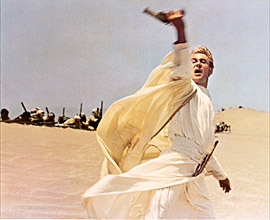
Some films belong to the director - it is the director's vision that makes them great. Some belong to the writer - the script is solid gold. This film belongs to the cinematographer. Director of Photography Freddie Young won the first of three Oscars in a row working with David Lean with this masterpiece of desolate beauty.
The music and acting style seems a little florid by modern standards, but the overall experience is too grand to be let down by such petty things. This is a true epic. Not only is it a very (and perhaps unnecessarily) long film telling a sweeping tale of flawed heroism in a wonderfully majestic setting, but the story behind the film is equally impressive.

The film is based on the real T E Lawrence's arguably exaggerated autobiography "Seven Pillars of Wisdom", covering his involvement in the Arab Revolt against the Turks during World War I. At the time he was seen as a dramatic paladin, largely thanks to the theatrical efforts of photo-journalist Lowell Thomas (on whom the Jackson Bentley character is based), but this film depicts Lawrence as a strange and conflicted character - vain and modest, moral and immoral, heroic and cowardly.
Fascinatingly, this production left an unexpected legacy. King Hussein of Jordan lent an entire brigade of his Arab Legion as extras for the film, so most of the "soldiers" are played by real soldiers. Hussein frequently visited the sets and became enamored of a young British secretary, Antoinette Gardiner, who became his second wife in 1962. Their oldest son, Abdullah II King of Jordan, ascended to throne in 1999.
Lawrence himself left an unexpected legacy - when he was fatally injured in a motorcycle accident in May 1935 (age 46), one of the doctors attending to him was a young neurosurgeon, Hugh Cairns. He was so moved by the tragedy that he began a lifelong and ultimately successful campaign to make crash helmets compulsory for motorcycle riders, which has saved countless lives.
Trivia: Although nearly four hours long, this film has no women in speaking roles. I can't think of another film that features no women, can you?
Some films belong to the director - it is the director's vision that makes them great. Some belong to the writer - the script is solid gold. This film belongs to the cinematographer. Director of Photography Freddie Young won the first of three Oscars in a row working with David Lean with this masterpiece of desolate beauty.
The music and acting style seems a little florid by modern standards, but the overall experience is too grand to be let down by such petty things. This is a true epic. Not only is it a very (and perhaps unnecessarily) long film telling a sweeping tale of flawed heroism in a wonderfully majestic setting, but the story behind the film is equally impressive.

The film is based on the real T E Lawrence's arguably exaggerated autobiography "Seven Pillars of Wisdom", covering his involvement in the Arab Revolt against the Turks during World War I. At the time he was seen as a dramatic paladin, largely thanks to the theatrical efforts of photo-journalist Lowell Thomas (on whom the Jackson Bentley character is based), but this film depicts Lawrence as a strange and conflicted character - vain and modest, moral and immoral, heroic and cowardly.
Fascinatingly, this production left an unexpected legacy. King Hussein of Jordan lent an entire brigade of his Arab Legion as extras for the film, so most of the "soldiers" are played by real soldiers. Hussein frequently visited the sets and became enamored of a young British secretary, Antoinette Gardiner, who became his second wife in 1962. Their oldest son, Abdullah II King of Jordan, ascended to throne in 1999.
Lawrence himself left an unexpected legacy - when he was fatally injured in a motorcycle accident in May 1935 (age 46), one of the doctors attending to him was a young neurosurgeon, Hugh Cairns. He was so moved by the tragedy that he began a lifelong and ultimately successful campaign to make crash helmets compulsory for motorcycle riders, which has saved countless lives.
Trivia: Although nearly four hours long, this film has no women in speaking roles. I can't think of another film that features no women, can you?
Thursday, July 27, 2006
The African Queen
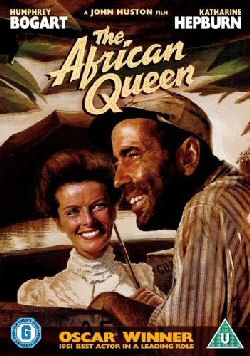
#136 at time of writing.This film starts off slow, and shows its age, but give it twenty minutes and you're strangely hooked. The bulk of the story is taken up with the witty banter between Katharine Hepburn and Humphrey Bogart's characters while they meander down an African river to avoid - and then pursue - German soldiers during World War I.
There are many wonderful exchanges while Rose Sayer, the high-minded missionary, is brought gently down to earth by Charlie Allnut, the gin-swilling water-rat. A fine balance is achieved between comedy, realism and romance. This role deservedly won Humphrey Bogart the only Oscar of his career.
Behind the scenes, to show her disgust with the amount of alcohol that John Huston (the director) and Humphrey Bogart consumed during filming on location in the Congo, Katharine Hepburn drank only water. As a result, she suffered a severe bout of dysentery.
Labels:
Congo,
films,
Humphrey Bogart,
John Huston,
Katharine Hepburn,
movies,
Oscar,
review,
The African Queen,
World War I
Subscribe to:
Posts (Atom)