Celebrating Great Films


Showing posts with label British actors. Show all posts

Monday, September 05, 2022

Best of the pandemic: Inside, Host, Staged

I am in rank admiration of the artists who managed to create something despite the enormously disruptive and devitalising Covid-19 lockdowns. Doubly so, those artists that created something that was a product of the lockdowns. These geniuses not only kept working, but used the dire situation to their advantage and created something that could not have existed otherwise. For me, there were three high points in this category.


First, and greatest, Bo Burnham's Inside. Bo Burnham was one of the first viral YouTubers, making cheeky musical comedy videos from his bedroom at the age of 16, way back in 2006 when YouTube was new. He parlayed his success into stand-up tours and TV specials of exceptional quality, proving his talent ran remarkably deep. This winning streak came with its pressures, and culminated in a mental breakdown - he sang about his fragile mental state in this 2016 song which makes me cry every time despite the fact that it's mostly about burritos.

He temporarily retired from the stage to make Eighth Grade, which is a masterpiece of realist teenage awks, and one of my favourite films. Then, after five years of dodging the limelight, he decided he was ready to tour again, only for the coronavirus pandemic to put the kibosh on his and everyone else's plans. But he would not be vanquished. Instead, he challenged himself to make a TV special within the constraints of lockdown, stuck in his studio and doing everything himself - filming, lighting, sound, editing, and a presumably hilarious string of unusual Amazon orders for all the comedy props.


We named our kitten Bo Burnham

The result of his efforts is one of the funniest, saddest, scariest, most cutting and most important things ever committed to the small screen. Not only does he capture the ennui of lockdown perfectly, but he satirises and dramatises our Internet-driven culture in a frighteningly prescient way. In a world where we are constantly bombarded by too much, very few artists have captured that dangerous and disorienting "funny feeling" so well.

During the Covid-19 lockdowns, video calls went mainstream as the only way to keep in touch with friends and family. I often ended up spending all day on a computer screen working remotely, followed by an evening on a computer screen socialising remotely. For whatever reason the app of choice for video calls was new kid on the block, Zoom. Director Rob Savage decided that having actors forced to isolate shouldn't stop him from making a horror film, so he made one based on a Zoom call.

One of the things that makes Host so much fun to watch is the chemistry between the actors. Having been brainwashed to socialise on Zoom, it felt like I was participating in the call myself, and I loved spending time with these people. Which made it even more terrifying when an unseen supernatural force started picking them off one by one... Brilliant.

Lastly, British comedy institutions Michael Sheen and David Tennant found the West End play they had been rehearsing for cancelled by Covid - at least, that's how the story goes - so instead they filmed a lightly fictionalised version of themselves bickering about what creative endeavour they should undertake instead, aiming to rise above all the other suddenly-out-of-work actors who had allowed themselves to be defeated by the pandemic.

The result, Staged, is hilarious. The two of them clearly have great affection for each other, and once again the Zoom call format makes you feel part of the banter. Granted, the second series was not as good, but the first six episodes are comedy gold. It's also fun to get a glimpse inside the homes of these familiar and beloved actors (kudos to David's wife and Michael's girlfriend for getting involved too). Perfect lockdown telly, that will still be a joy to watch long after the pandemic is but a distant memory.

Sunday, February 02, 2014

12 Years a Slave

#90 at the time of writing.

This is the only slightly embellished true story of Solomon Northup, a free black man from New York who was abducted and sold into slavery in the mid-19th century American deep south. Director Steve McQueen's wife noted that there are more films about Roman slave Spartacus than about the far more relevant and immediate Atlantic slave trade.

It's interesting that it took a British-helmed film to really get under the skin of what it was like to be a slave in America - an unsentimental and unflinching portrait. There's all the brutality and abuse of Django Unchained (which I saw last year), but with none of the ridiculousness.

I was perhaps a little reluctant to go and see this, which reinforces my suspicion that my favourite reason to watch a film is escapism. This is the opposite of escapism. I'm not in a rush to watch Steve McQueen's critically acclaimed previous films Hunger and Shame.

Sunday, January 16, 2011

The King's Speech

#185 at time of writing.

Never have I had so much trouble getting tickets at my own local cinema; this film is proving immensely popular. No doubt partly due to the royal fervour stirred up by the imminent marriage of Prince William to Kate Middleton.

A hot tip for the Oscars, this movie appeals on three levels. First, as the compelling personal story of how King George VI - with the help of his speech therapist Lionel Logue - coped with having power thrust upon him when Edward VIII abdicated. The two lead roles are played brilliantly by Colin Firth and Geoffrey Rush. The filmmakers had access to Logue's previously undiscovered diaries, so they had a first-hand account on which to base their portrayal of his relationship with the King.

Secondly, the film appeals as a period piece, full of glimpses of 1920s and 30s London shrouded in fog, when cars and wireless radios were a novelty and everybody of note spoke with impeccable RP. Nowhere are the charming traditions and antiquated strictures of interwar Britain more pronounced than in the halls of the monarchy.

And thirdly, for being set against a time of great crisis for the monarchy, for Britain and for the world, when tensions and attitudes built up to a flashpoint that culminated in the declaration of World War II - a war that marked the watershed between the British Empire and the modern world we know today.

The cinema audience clapped when the credits rolled, even though I doubt any of the makers were there to appreciate the gesture. I wouldn't be surprised if the same thing happens at many other screenings - there's just something about the pomp and ceremony of the film that rouses one to spontaneous applause.

Click here to hear the real King George VI's radio address to the nation on September 3rd 1939, the titular speech of the film. Listening to the King's halting words, it is easy to imagine Lionel Logue in the recording booth with him, gesturing and encouraging him to overcome his stammer.

Saturday, May 29, 2010

Four Lions

Four Lions
Unranked at time of writing.

At the time of writing this film has a score of 8.2 on IMDb, but - being a low-budget indie British film - it doesn't have enough votes to get it into the Top 250.

I LOVE that British cinema can tackle such brave material. Hollywood could never be so blasé about domestic terrorism. The director Chris Morris is best known in the UK for a couple of extremely controversial TV comedy series back in the late 90s/early Naughties, in particular an episode of Brass Eye that unflinchingly parodied and exploited our nation's uneasiness about paedophiles. With this comedy about inept suicide bombers, his ability to put his finger on the core of our cultural paranoia and push the boundaries seems to be as strong as ever.

Four Lions is funny, edgy (thankfully not nearly as bad taste as it could have been), and intelligent. Most of the jokes come from how stupid the wannabe terrorists are, and a careful balance is struck to make sure that all cultures are mocked equally. I enjoyed it, but I came out the cinema feeling more could have been done with it. I wanted to know more about why the characters had decided to become terrorists. I wanted something deeper. Perhaps I wanted too much - the fact that Chris Morris has squared up to these topics at all is already much further than any sane man would go, and I am grateful for that.

There have been some truly excellent British films recently which are scored lower on IMDb, but I think deserve more. In particular, I recently watched The Disappearance of Alice Creed - man, Gemma Arterton can act - and the brilliant An Education.

(Trivia from IMDb, if you believe it: "On January 23rd 2010, Four Lions had its world premier at Sundance. On the same day, the UK 'terror threat' level was raised to 'severe' due to non-specific 'chatter'.")

Monday, November 23, 2009

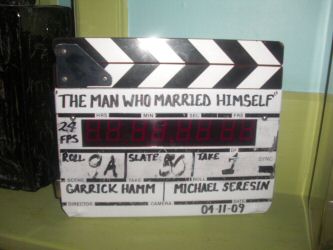
The Man Who Married Himself

Remember a few posts ago I said that a film was being made from one of my short screenplays?

I've been a bit quiet about it because it seemed to good to be true, but a couple of weeks ago I visited the set during filming - so now I know it's really happening!

The Man Who Married Himself


The short is called "The Man Who Married Himself", and it stars Richard E Grant, Emilia Fox, Celia Imrie and Warren Clarke. Directed by Garrick Hamm (who co-wrote the screenplay with me), a big-time designer who's hoping to break into filmmaking. It's currently in post-production.

It was awesome visiting the set and seeing dozens of people haring around with lighting equipment and odd props and things, all working to make my story come to life. I tried to keep a low profile, but it was nice that whenever I introduced myself as the writer I was treated like a VIP (which is not the Hollywood way, I reckon, so I appreciated it even more).

I chatted to Richard and Emilia - they were both very friendly and complimentary about the script. Richard even asked me to send him the novel I'm working on! He's been asked to be a Booker judge (although he said he's not sure if he'll accept as it involved reading about four books a week for six months), so it's a great honour if he wants to read my stuff.

Pardon me for effusing, but I'm excited!

Now I am working on a feature length film script to try and take advantage of the momentum from this short. Watch this space...

Monday, July 13, 2009

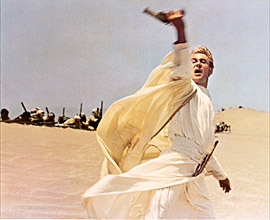
Lawrence of Arabia

#41 at time of writing.

Some films belong to the director - it is the director's vision that makes them great. Some belong to the writer - the script is solid gold. This film belongs to the cinematographer. Director of Photography Freddie Young won the first of three Oscars in a row working with David Lean with this masterpiece of desolate beauty.

The music and acting style seems a little florid by modern standards, but the overall experience is too grand to be let down by such petty things. This is a true epic. Not only is it a very (and perhaps unnecessarily) long film telling a sweeping tale of flawed heroism in a wonderfully majestic setting, but the story behind the film is equally impressive.

Lawrence of Arabia


The film is based on the real T E Lawrence's arguably exaggerated autobiography "Seven Pillars of Wisdom", covering his involvement in the Arab Revolt against the Turks during World War I. At the time he was seen as a dramatic paladin, largely thanks to the theatrical efforts of photo-journalist Lowell Thomas (on whom the Jackson Bentley character is based), but this film depicts Lawrence as a strange and conflicted character - vain and modest, moral and immoral, heroic and cowardly.

Fascinatingly, this production left an unexpected legacy. King Hussein of Jordan lent an entire brigade of his Arab Legion as extras for the film, so most of the "soldiers" are played by real soldiers. Hussein frequently visited the sets and became enamored of a young British secretary, Antoinette Gardiner, who became his second wife in 1962. Their oldest son, Abdullah II King of Jordan, ascended to throne in 1999.

Lawrence himself left an unexpected legacy - when he was fatally injured in a motorcycle accident in May 1935 (age 46), one of the doctors attending to him was a young neurosurgeon, Hugh Cairns. He was so moved by the tragedy that he began a lifelong and ultimately successful campaign to make crash helmets compulsory for motorcycle riders, which has saved countless lives.

Trivia: Although nearly four hours long, this film has no women in speaking roles. I can't think of another film that features no women, can you?

Monday, January 26, 2009

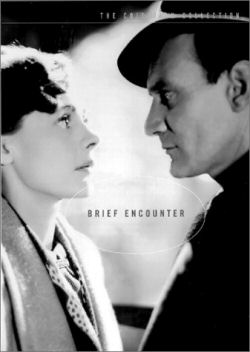
Brief Encounter

Brief Encounter#158 at time of writing.

I saw Kneehigh Theatre's adaptation of Brief Encounter at the Haymarket - it was the best piece of theatre I saw in 2008. In fact, I'd rank it in my top three or four favourite shows of all time. (In case you're curious, the others would be Masque of the Red Death, Avenue Q, and The Woman in Black.) They're still touring the show - see it while you can.

After the stage show, I felt like I'd seen the film - like I'd laughed and cried and fallen in love with it. So when I finally did see the film last week it felt warm and familiar, like sitting in front of an open fire at Christmas. The film didn't blow me away (like the play did), but it was quiet, and sad, and beautiful, and nostalgic.

Celia Johnson and Trevor Howard's performances are restrained and realistic, far from the stagy melodrama I tend to expect from golden oldies. This film is like a precious museum exhibit, a glimpse into the mores of 1940s life. It seems almost comical now that it was banned by the Irish censorship board on the grounds that it portrayed an adulterer in a sympathetic light.

It’s thoroughly British, with occasional comic touches, and it’s so rooted in the 1940s that a film will never be made like it again. People were brasher then, accents were stronger, and social attitudes to affairs quite different. The period of the film gives it much of its charm.

Brief Encounter is based on a short play by Noel Coward, and it earned director David Lean his first Oscar nomination.

Sunday, January 08, 2006

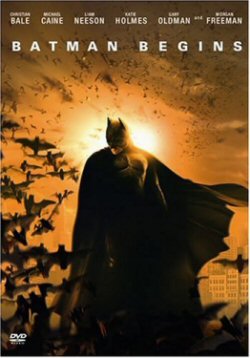
Batman Begins

Batman Begins#111 at time of writing.

This is what a Batman film should be. In fact, this film outdoes all other serious superhero films, ever.

Christopher Nolan hasn't made a lot of films yet, but he already proved his capacity for genius with Memento, and now he's risen to the challenge of a big-budget blockbuster.

I have to admit I was skeptical after the last two Batman films, particularly Batman & Robin, which easily makes it into my Worst 10 Films of All Time. But this film is something special. Based on the darkest and most grounded of the graphic novels, and infused with a compelling realism, this film gets a ten out of ten from me.

The film rewrites the history of the Dark Knight, giving us glimpses into Bruce Wayne's childhood, and his reasons for becoming Batman, without ever being schmaltzy. The resulting epic makes the possibility of a Batman more believable than ever before. And it makes for a thrilling ride.

And the thing that seals the deal is that every single supporting character could stand alone. A monumental achievement considering the first draft of the script was written in less than two months. And helped along by the all-star line-up cast, of course.

It makes me proud as well that a lot of this film was done with British actors and a British studio. Gotham City is largely a full-size indoor city built in a hangar in Bedford (which was previously used for building Zeppelin-sized airships). And the Batmobile is not CGI, it is a £500,000 monster built by Brits at Shepperton Studios.

Hope is reborn for the Batman franchise.