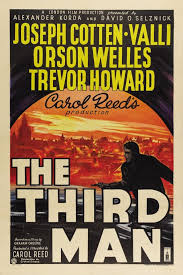
#75 at the time of writing.
In 1999 the British Film Institute selected The Third Man as the best British film of the 20th century. Having finally seen it for the first time, I can understand that accolade.
Right in the first few minutes, with Anton Karas's jaunty zither theme setting the tone, and an opening scene that signals the seemingly effortless genius of Graham Greene's script, this film announces itself as something special.
The slower pacing of golden oldies in comparison to modern movies sometimes puts me off, but here the pace was just right. I was glued to the screen by the stylishly skewed camera angles (so-called Dutch angles), the angsty post-war historical backdrop, the cleverly twisty unravelling of the mystery, and the wonderful noir-ness - but above all I enjoyed spending time with the characters.
Without wishing to give anything away, I especially enjoyed the very last scene - I thought it perfectly fitting - and I was surprised to see that Graham Greene wanted the opposite to happen. I'm glad that director Carol Reed and producer David O Selznick got their way in the end.
Showing posts with label BFI. Show all posts
Saturday, June 15, 2013
The Third Man
Labels:
Anton Karas,
BFI,
Carol Reed,
David O Selznick,
films,
Graham Greene,
movies,
review,
The Third Man
Thursday, January 13, 2011
Ultimate UK Film Chart
I was looking today at the BFI's Ultimate Film Chart, the all-time top 100 films based on UK cinema admissions estimates. Quite a few unexpected entries on there. Like, did you know that the fifth most watched film in UK cinema history is Spring in Park Lane?
I got to wondering, is The Sound of Music's 30 million seats sold as impressive as the 28 million seats sold for Snow White and the Seven Dwarfs, given that the UK population grew significantly in the 27 years between the latter film and the former? What proportion of the UK population attended these films?
So, I plotted seats sold and UK population on the same graph. The x axis is films (in chronological order), and the y axis is 000s of people and 000s of seats sold.
The three big peaks, in chronological order, are Snow White and the Seven Dwarfs (59.1% of the population); Gone with the Wind (an impressive 73.2%); and The Sound of Music (55.5%). Of course, those proportions assume each person only attended once, which is plainly flawed, but still the trend is clear. In terms of proportional attendance, the golden age of cinema is far behind us.
Subscribe to:
Posts (Atom)